
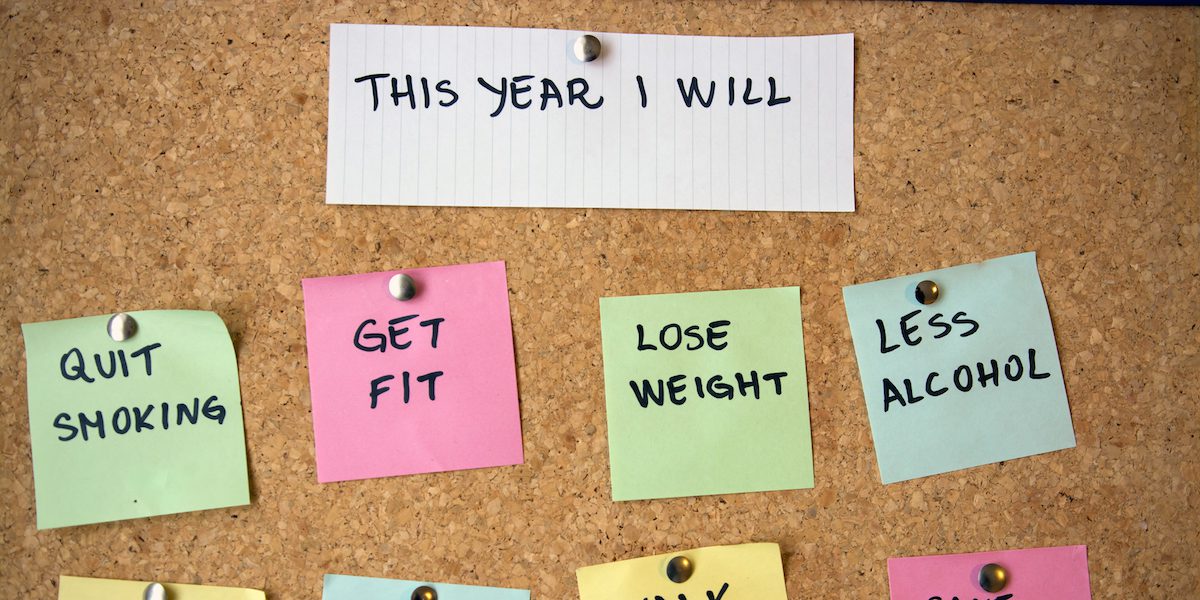
Happy New Year! For most of us, the New Year means resolutions—many of which revolve around getting healthier. The problem is, most of these resolutions are destined to fail. How can you make sure your aspirations for 2026 stick? Here are a few ways to help you achieve those lofty New Year’s resolutions.
New Year, New You—Then and Now
The practice of setting resolutions for the new year goes back millennia to the Ancient Babylonians and Romans. But the practice of making—and breaking—New Year’s resolutions as we know it today appears to have taken hold in the early 19th century. While resolutions have always involved improving some aspect of one’s life, today’s goals typically relate to getting healthier. Whether it’s losing weight, getting into shape, eating better, or all of the above, forming healthier habits are by far the most popular New Year’s resolutions. Little surprise since only about three percent of all American adults are considered to lead a healthy lifestyle.1
Set the Right Type of Goals
So how do you set your New Year’s resolutions up for success? A 2020 study published in the journal PLOS ONE suggests that it’s the type of goal that makes the difference. Approach-oriented goals are more successful than avoidance-oriented goals, according to researchers. What is an approach-oriented goal you ask? It’s something that you can add to your life as opposed to something you want to take away. Turns out that focusing on what you can’t do or can’t have may not be the best method for achieving your goals. This played out among the New Year’s resolution–makers taking part in the study: 58.9 percent of participants who set approach-oriented resolutions considered themselves successful, compared to 47.1 percent of participants who set avoidance-oriented resolutions. And after a one-year follow-up, 55 percent of respondents considered themselves successful in keeping their resolutions.2
Divide Your Big Long-Term Goal into Smaller Short-Term Goals
It takes time to achieve big things, and that’s especially true for resolutions. No matter how motivated you are to make a change right now, it isn’t going to happen overnight—or even next week. But maintaining that level of motivation is tough over the long haul. That’s why focusing on the means instead of the end goal itself can help make your resolution more attainable.3 The best way to do this is to break up big goal into smaller, more manageable ones. It feels good to accomplish things, and these shorter-term goals can keep you energized to see your resolution through.
Share Your Goals, But Not with Everyone
Despite previous evidence indicating that widely broadcasting your goals can lead to a premature sense of accomplishment, the truth is that sharing your objectives can lead to a better outcome—but only if you tell the right people. A study out of Ohio State University showed that people are motivated by sharing their goal with someone they respected because they care about how that person would evaluate them.4 So rather than posting your 2026 goals on social media, confide in a mentor or someone you look up to.
Up Your Supplement Game
More than 70 percent of Americans take one or more dietary supplements in an effort to easily improve their health.5 And that can be an effective strategy if you target key bodily systems like your cardiovascular, cognitive, immune, and structural health. Opt for supplements that provide heart-healthy benefits like Aged Garlic Extract (AGE), a proprietary ingredient that has been clinically shown to reduce blood pressure in patients with uncontrolled hypertension, and it also has the potential to improve arterial stiffness, inflammation, and gut microbial profile.6,7 AGE can also support a strong immune system, helping you weather any seasonal pathogens that may come your way.8 Other nutrients that support cardiovascular health include vitamins B6, B12, and folate.9
Don’t make New Year’s resolutions that are destined to fail. By taking a science-based approach to achieving your goals, 2026 can be the year that you finally realize those healthy resolutions.
References
- Loprinzi PD. Healthy Lifestyle Characteristics and Their Joint Association With Cardiovascular Disease Biomarkers in US Adults. Mayo Clinic Proceedings. 2016;91(4):432-442.
- Oscarsson M. A large-scale experiment on New Year’s resolutions: Approach-oriented goals are more successful than avoidance-oriented goals. PLoS ONE. 2020;15(12):e0234097.
- Krause K. How to beat procrastination: The role of goal focus. European Psychologist. 2014;19(2):132–44.
- Klein HJ. When goals are known: The effects of audience relative status on goal commitment and performance. Journal of Applied Psychology. 2020;105(4):372–89.
- Liu L, Tao H, Xu J, et al. Quantity, duration, adherence, and reasons for dietary supplement use among adults: Results from NHANES 2011-2018. Nutrients. 2024;16(12):1830.
- Reid K. The Effect of Kyolic Aged Garlic Extract on Gut Microbiota, Inflammation, and Cardiovascular Markers in Hypertensives: The GarGIC Trial. Frontiers in Nutrition. 2018;5.
- Wlosinska M. The effect of aged garlic extract on the atherosclerotic process – a randomized double-blind placebo-controlled trial. BMC Complementary Medicine and Therapies. 2020;20(132).
- Percival SS. Aged garlic extract modifies human immunity. Journal of Nutrition. 2016;146(2):433S-6S.
- Lonn E, Yusuf S, Arnold MJ, et al. Homocysteine lowering with folic acid and B vitamins in vascular disease. New England Journal of Medicine. 2006;354(15):1567-77.
This article is for informational purposes only. This article is not, nor is it intended to be, a substitute for professional medical advice, diagnosis, or treatment and should never be relied upon for specific medical advice.
Share this Post